
Why Group Counseling Might Be Worth Considering
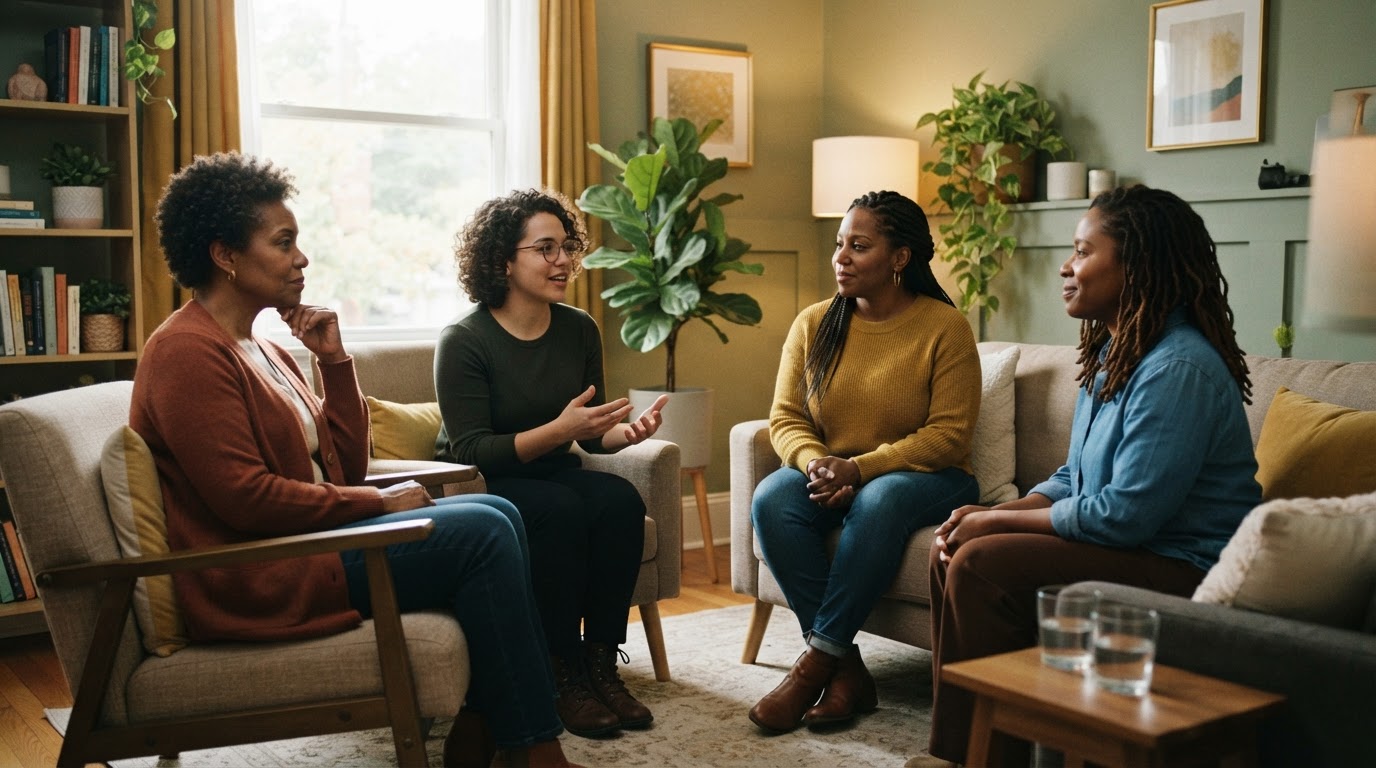
When most people think about counseling, they picture sitting one-on-one with a therapist. And while individual counseling can be incredibly helpful, sometimes there is value in being in a space with people who understand parts of what you are going through.
That is where group counseling can offer something different.
"Wait… You Want Me to Talk About This in Front of Other People?"
It is probably one of the first thoughts that comes up.
What if I do not know what to say? What if I do not want everyone knowing my business? What if I just want to listen?
Group counseling does not mean walking into a room and immediately sharing the most personal parts of your life. Groups have structure and boundaries, and you get to decide what you are comfortable sharing.
Sometimes listening is participation.
And sometimes someone says something you have thought a hundred times but never said out loud.
Oh. It is not just me.
There is actually a name for that. Yalom and Leszcz (2020) describe universality as one of the therapeutic factors of group counseling — the realization that some of the things we thought we were experiencing alone are shared by others.
Groups Can Help Us Notice Our Patterns
A lot of what brings us to counseling involves other people: relationships, boundaries, communication, trust, belonging, identity, or figuring out why we keep finding ourselves in the same situations.
Those patterns can show up in a group, too.
Maybe you are always taking care of everyone else.
Maybe you stay quiet even when you have something to say.
Maybe you automatically compare your experience to someone else's and decide yours is not "bad enough."
Maybe receiving support feels much harder than giving it.
These are not failures. They are information.
A group gives you a place to notice those patterns, understand them, and practice doing something differently.
You Get More Than One Perspective
Your counselor brings clinical knowledge and guidance. Group members bring something else — their own experiences and perspectives.
Someone may ask a question you had not considered. Someone may put words to something you have been struggling to explain. You may hear how another person approached a similar situation and realize you want to handle yours completely differently.
The point is not for the group to tell you what to do.
It is having more perspectives to consider while you figure out what works for you.
You Do Not Have to Be a "Group Person"
You do not have to be outgoing. You do not have to love talking in front of people. And you definitely do not have to share everything.
Group counseling is often more affordable than individual counseling, but cost is not the only reason to consider it. Connection, shared experiences, different perspectives, and the opportunity to learn alongside others are all part of what can make group counseling valuable (American Group Psychotherapy Association [AGPA], 2021).
Some things are easier to work through one-on-one. Other things feel different when you are sitting with people who get it.
Sometimes the most helpful part of group counseling is realizing:
I am not the only one dealing with this.
References
American Group Psychotherapy Association. (2021). Practice guidelines for group psychotherapy.
Yalom, I. D., & Leszcz, M. (2020). The theory and practice of group psychotherapy (6th ed.). Basic Books.

Ready to take the next step?
Schedule a consultation to discuss how we can support you.